

Choose pillow height by how your head and neck sit on your usual mattress after the pillow has settled. As a starting point, side sleepers often need more loft than back sleepers, while stomach sleepers generally need a low profile. But there is no single height that suits everyone: mattress sink, shoulder width, pillow fill and comfort all change the result.
What Pillow Height Means
Loft is a pillow’s height or thickness when it is not compressed. It is not the same as firmness or support. A pillow can look tall on a shelf but flatten significantly under your head; another may start lower and hold its shape more consistently.
For that reason, product measurements are a useful filter, not the final answer. Check whether a manufacturer lists the pillow’s height before use, whether the fill can be adjusted, and whether the product is designed to be used in a particular orientation. Different brands may use “low,” “medium” and “high” differently, so treat those labels as broad categories rather than standardized measurements.
Sleep Foundation describes common loft groupings as low (under 3 inches), medium (3–5 inches) and high (over 5 inches). These are general reference bands, not a prescription. A pillow’s compressed height and your sleeping setup matter more than choosing a category by name alone.
A Starting Point by Sleep Position
Your usual sleep position is a practical first filter because it changes the space between your head and the mattress. Use the table below to build a shortlist, then verify the fit while lying down in your normal position.
| Sleep position | Starting point | What to check |
|---|---|---|
| Side sleeping | Often medium-to-high loft | The pillow fills the space between the side of the head and mattress without pushing the head upward. |
| Back sleeping | Often low-to-medium or medium loft | The head stays supported without the chin being pushed toward the chest or tipping backward. |
| Stomach sleeping | Usually low loft; some prefer no head pillow | A thick pillow may turn the head and neck into a more pronounced angle. Comfort and any advice from a clinician still matter. |
| Combination sleeping | A flexible, adjustable or middle-ground option may be worth trying | Check whether the pillow stays comfortable when you roll between your main positions. |
These are starting points, not rules. The Sleep Foundation’s pillow-shopping guidance similarly links loft to sleeping position, while emphasizing that personal fit and construction also matter.


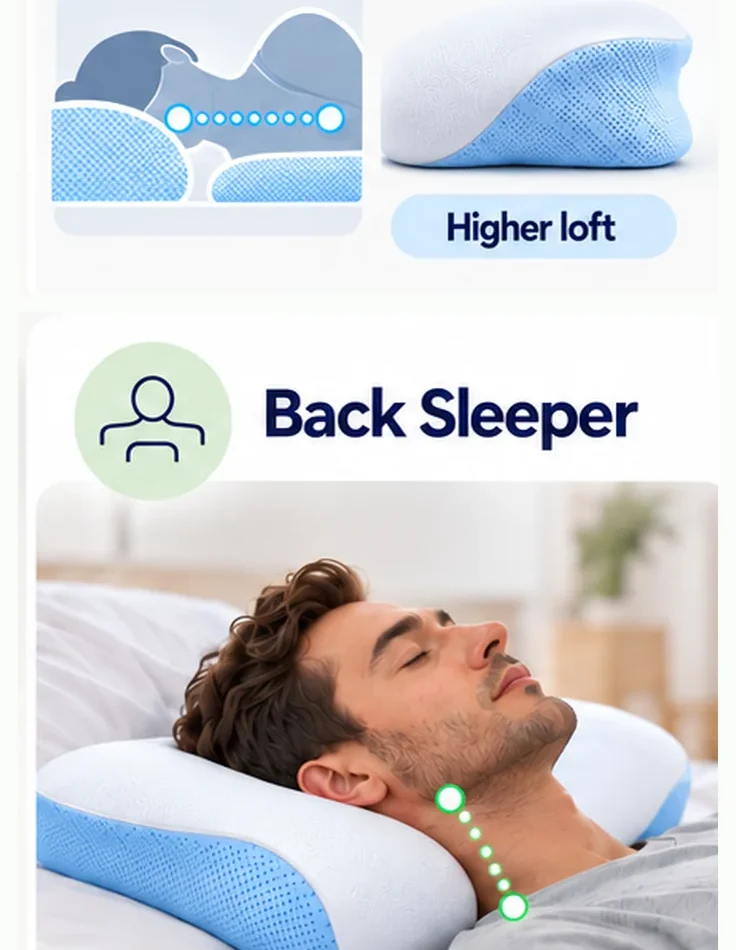

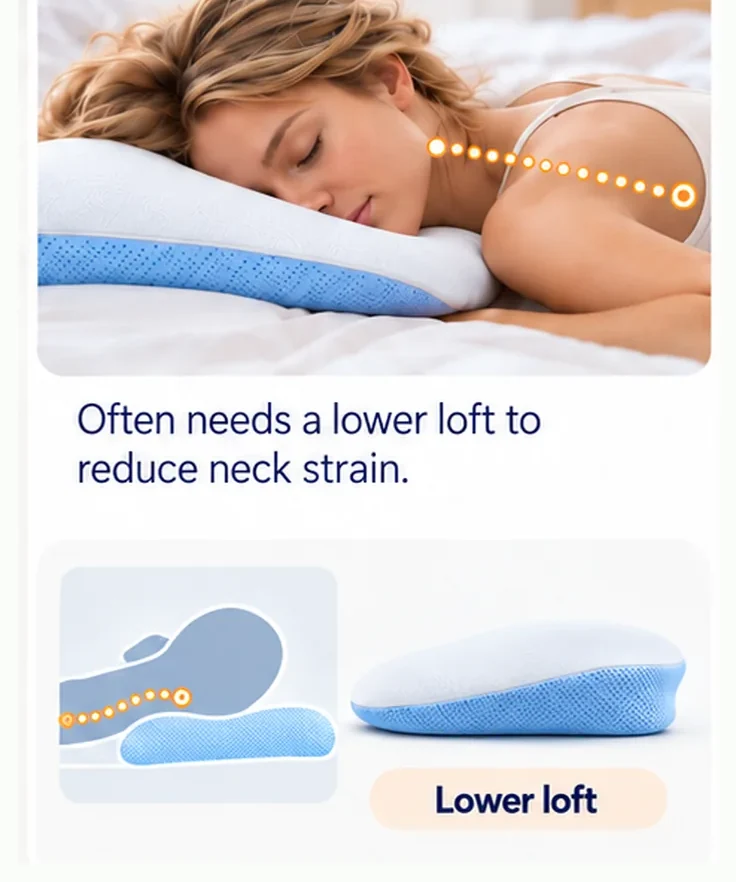
How the Mattress Changes the Fit
Your shoulder and torso sink into a mattress to different degrees depending on the mattress and your body. On a softer surface, the shoulder may sink farther, leaving a smaller gap between your head and the mattress. On a firmer surface, the shoulder may sink less, so more pillow height may be needed to fill that gap. A thick topper can change the same relationship.
This is why pillow height should be checked on the bed you actually use. A pillow that seems right on a showroom display, guest bed or firm test surface may feel too tall or too flat on your own mattress. Recheck your choice if you change your mattress, add a topper or move to a different bed for an extended period.
Think of mattress sink and pillow loft as a pair. The more your shoulder sinks into the mattress, the less height may be needed to fill the remaining space; the less it sinks, the more loft you may need. Treat this as a fit clue, not a formula.
Shoulder Width and Body Shape
Two people who sleep in the same position can need different pillow heights. Shoulder width is one factor, but head size, the angle at which you sleep, how far the shoulder sinks and whether you draw the pillow under your neck also influence the fit.
- Broader shoulders: you may need more loft when side sleeping, especially on a firm mattress. Check that the pillow does not push your head away from the mattress.
- Narrower shoulders: a lower or more compressible pillow may work better than a very tall fixed contour.
- Changing positions: if you roll from side to back, a strong side-sleeper profile may feel too tall in the back position. An adjustable pillow or a shape with different support zones may be worth considering.
- Shoulder discomfort or restricted movement: do not force yourself into a position just to match a height recommendation. Comfort and individualized clinical guidance take priority.
These are practical considerations, not body-type rules. A mirror or side-on photo taken by another person can sometimes help you notice whether your head appears tilted, but it should only supplement how the pillow feels and how you wake up. It does not replace professional advice when symptoms persist.
Why Compression Matters
The number on a product listing usually describes the pillow before it is carrying your head. Its effective loft depends on the material, fill amount, construction and your weight distribution. That difference can be especially noticeable with loose fiber fill, down-alternative or shredded foam compared with a more structured contour.

- Adjustable fill: can let you add or remove material in small steps, but may need a few rounds of adjustment and redistribution.
- Solid or contoured foam: tends to have a more defined shape, although it still compresses and may feel different with temperature and use.
- Soft, moldable fill: can be shaped to personal preference, but may shift or flatten during the night.
Do not assume a firmer pillow is automatically the right height, or that a softer pillow cannot support you. Firmness describes feel; loft describes height; support is how the pillow maintains a comfortable position under load. They overlap, but they are not interchangeable.
Fixed-Contour vs. Adjustable-Fill Pillows
A fixed-contour pillow has a predefined shape and loft, while an adjustable-fill pillow lets you add or remove filling to change its height. Neither type is automatically better: the useful choice is the one that fits your sleeping position and remains comfortable on your own mattress.
Fixed-contour pillow
A defined shape and loft. Choose a model whose profile fits your position and mattress; adjustment may be limited.
Defined shape · less adjustableAdjustable-fill pillow
Add or remove filling in small steps to fine-tune the loft. Recheck after the fill settles and redistribute it as directed.
Flexible loft · requires trial| Feature | Fixed-contour pillow | Adjustable-fill pillow |
|---|---|---|
| How height is set | The shape and loft are built into the pillow; some models can be rotated according to the maker’s instructions. | You can usually add or remove small amounts of fill to fine-tune loft. |
| Main advantage | A defined, repeatable shape without routine fill adjustments. | More flexibility to change the height if the first setting feels too high or too low. |
| Trade-off | If the contour or loft does not suit you, adjustment may be limited. | It can take several small trials to find a comfortable amount, and the fill may settle over time. |
| May suit | Someone who prefers a structured shape and has found a contour that fits. | Someone still narrowing down their preferred height or who wants the option to adjust it. |
Whichever type you consider, verify the manufacturer’s instructions and product dimensions. Compare usable loft, not just the pillow’s height before compression, and reassess the fit after lying in your normal position.
How to Check Your Pillow Height at Home
Test a candidate on your regular mattress, with your usual pillowcase, and give the fill a moment to settle. The aim is a comfortable, reasonably neutral head-and-neck position, not a rigid posture or a perfect line measured with a ruler.
Start in your main sleep position
Lie down the way you normally fall asleep. Place the pillow where you would naturally position it rather than pulling it unusually far under the shoulders or neck to make it fit.
Notice whether your head is tipped
On your side, notice whether your head seems to fall toward the mattress or is pushed up toward the ceiling. On your back, notice whether your chin is forced down toward your chest or your head tips noticeably backward.
Check the neck and shoulder contact
The pillow should support the head and the natural space under the neck without creating a hard pressure point at the shoulder. You should not need to tense your neck to hold the position.
Repeat after the pillow settles
Give the material time to compress, then reassess. With an adjustable pillow, change the fill gradually and test again instead of removing or adding a large amount at once.
Use morning comfort as feedback
Notice whether you regularly wake with stiffness or feel the need to fold, bunch or reposition the pillow. A single night does not diagnose a problem, but a repeating pattern is a reason to reassess the fit.
Cleveland Clinic’s guidance on choosing a neck-friendly pillow emphasizes avoiding a head position that bends the neck down or to one side. Use the observations above as a practical check, not as a medical test.
Common Pillow-Height Mistakes
- Choosing by the uncompressed number alone. A pillow’s listed height may not reflect how much loft remains under your head.
- Assuming taller always means better support. Too much height can tip the head; too little can let it drop.
- Ignoring the mattress. The same pillow can feel different on a soft mattress and a firm mattress.
- Changing several variables at once. If practical, test one adjustment at a time, such as loft, fill, or orientation, so you can tell what changed.
- Forcing a universal sleep-position rule. Most side sleepers start by considering more loft than back sleepers, but individual fit still decides.
- Stacking pillows to correct a mismatch. Stacking may shift or create an unstable angle. If you routinely need multiple pillows to reach a comfortable height, consider a better-matched or adjustable design.
When to Reassess the Fit
Recheck the height if you replace your mattress or topper, change your usual sleeping position, notice that the pillow has flattened, or find yourself repeatedly adjusting it during the night. Adjustable fill may be useful when your preferences or position vary, while a fixed contour may suit people who prefer a defined shape and find one that fits.
If neck pain, numbness, tingling, headaches or other symptoms persist or worsen, do not rely on pillow changes alone. Consider advice from a qualified healthcare professional, especially if symptoms are new, severe or associated with an injury.
Frequently Asked Questions
How high should my pillow be?
There is no single correct measurement. Start with your sleep position, shoulder width, mattress sink and how much the pillow compresses, then check whether your head and neck feel comfortably supported when lying down.
Is a higher pillow better for side sleepers?
Side sleepers often need more loft than back sleepers because the shoulder creates a larger gap to fill. But a pillow that is too high can push the head up, so test the effective height on your own mattress.
What pillow height is best for back sleepers?
Many back sleepers start with low-to-medium or medium loft. The pillow should support the head without pushing the chin toward the chest or allowing the head to tip too far backward.
Should stomach sleepers use a pillow?
Stomach sleepers often prefer a low-loft pillow, and some are more comfortable without a head pillow. Individual comfort and medical circumstances vary, so avoid treating one setup as mandatory.
Do I measure pillow height before or after lying on it?
Use the listed height to compare products, but judge fit after the pillow has compressed under your head. If a manufacturer gives both uncompressed dimensions and usable loft guidance, check how those measures are defined.
Can the wrong pillow height cause neck pain?
An unsuitable pillow can contribute to an uncomfortable neck position, but neck pain can have many causes. If pain persists or worsens, seek individualized medical guidance rather than assuming height is the only issue.
For a product-specific look at a fixed-contour design, read our Derila Ergo review. Read the Derila Ergo review.
- Sleep Foundation: How to Shop for Pillows (general guidance on loft and sleep position).
- Sleep Foundation: Pillow Research Methodology (describes common loft bands and how mattress firmness and sleeping position affect fit).
- Cleveland Clinic: Is Your Pillow Hurting Your Neck? (practical guidance on head and neck position).
This guide is general consumer information, not medical advice or the result of a laboratory test. Pillow fit is individual; follow clinician guidance for a diagnosed condition or persistent symptoms. Product specifications and retailer terms can change, so confirm them with the manufacturer before buying.
View the 70% offer on Derila’s site. Check the final price and shipping before buying.
We may earn a commission if you buy through this link.